O‘ahu Fresh

  • Sign Up
  • This Week’s Newsletter
  • Member Login
  • How It Works
    • Produce Bag Options
    • Delivery Areas
    • Online Marketplace
    • Wholesale
    • FAQs
    • Gift Certificates
  • Producers
  • This Week’s Bag
    • Cooking In Quarantine
    • Recipes
    • Ingredients
    • Latest Newsletter
  • About Us
    • Oahu Food Hub
  • Local Agriculture
    • Resources for Farmers
    • Hawaii Food & Farmers Series

‘Ulu

‘Ulu or breadfruit was first domesticated in the western Pacific and today is grown on most Pacific Islands. It continues to be an important staple crop and a component of traditional agroforestry, grown as both a subsistence crop in home gardens and farms. As a dietary staple it is comparable in importance to tropical staples such as taro, plantain, cassava, sweet potato and rice.  The name breadfruit is derived from the texture of ripe fruit when cooked, which is similar to freshly baked bread, though it has a potato like flavor. Ripe fruit have yellow or yellow-brown skin and soft, sweet, creamy flesh that can be eaten raw or cooked. ‘Ulu is a versatile crop and can be eaten at all stages of maturity. The fruit is a good source of dietary fiber, potassium, calcium, and magnesium.


Preparation:

Watch this Cooking ‘Ulu Video !
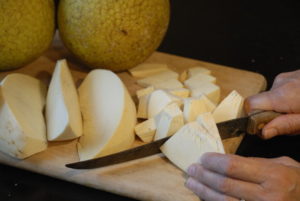
cooking5


Farms that grow ‘Ulu:

Kualoa Ranch

Kolohe Mix

Mixed Salad Greens are mix of various young lettuce-leaf varieties. Color, texture, taste, and shape all vary among lettuces. Together they make a tasty and convenient ready made salad mix.

mixed salad

Preparation:

They are prefect to go right in the salad bowl!

Farms that grow Mixed Salad Greens:

Kahumana Organic Farm & Cafe, Kunia Country Farms

Zucchini

Zucchini, like all members of the squash family, are native to the Americas. However, the varieties of squash typically called “zucchini” were developed much later in Italy following their introduction from the Americas. Zucchini have a reputation with home gardeners for having overwhelming production. However, they’re are many ways to eat the fruits both cooked and raw.

????????????????????????????????????

Preparation:

The skin is left in place on the fruit. Zucchini require little more than quick cooking. They can be prepared in a variety of techniques including steamed, boiled, grilled, stuffed and baked, barbecued, fried, etc. They can also be baked into a bread or cake. Zucchini can also be enjoyed raw, sliced or shredded in salads or lightly cooked.

Preparing-Fresh-Zucchini-11-Ways-to-Use-Summer-Squash


Farms that grow Zucchini:

Local Harvest

Cilantro

The leaves of the herb cilantro are also called coriander leaves or Chinese parsley. The dry seed of the plant is known as coriander. Cilantro is native to the Mediterranean and Turkey Minor region. The herb has delicate, lacy, bright green leaves and a pungent flavor. The leaves contain high amounts of antioxidants, essential oils, and vitamins, especially Vitamin A and Vitamin K.


Preparation

Cilantro is widely used for flavoring and as a garish throughout Caribbean, Latin American and Middle Eastern cuisine.

Cilantro should be washed and patted dry before using. It can be stored with the stems in water for several days in the fridge, wrapped in a wet paper towel, or in plastic bag for a week.


Farms that grow Cilantro

-Green Growers

Mango

mango

The mango is native to eastern India and Burma. The fruit is now grown around the world in frost-free tropical and subtropical climates. There are hundreds of named cultivars with various shapes, sizes, coloring, and texture. Fruit quality is often based on the scarcity of fiber, size of pit, and taste. Oils in the mango sap, skin, and even leaves can cause dermatitis. Even if one is sensitive to this, a peeled mango or drinking its juice usually causes no harm. Mangoes are high in Vitamin C and fiber and can be eaten in many ways.


Preparation

Mango Dices

  1. Stand the mango on your cutting board stem end down and hold. Place your knife about 1/4″ from the widest center line and cut down through the mango. Flip the mango around and repeat this cut on the other side. The resulting ovals of mango flesh are known as the “cheeks.” What’s left in the middle is mostly the mango seed.
  2. Cut parallel slices into the mango flesh, being careful not to cut through the skin. Turn the mango cheek 1/4 rotation and cut another set of parallel slices to make a checkerboard pattern.
  3. Here’s where you can choose your favorite method. Either “Slice and Scoop”—scoop the mango slices out of the mango skin using a large spoon—or “Inside Out”—turn the scored mango cheek inside out by pushing the skin up from underneath, and scrape the mango chunks off of the skin with a knife or spoon.


Mango Slices

  1. Slice each side just past the seed.
  2. Slice flesh without breaking the skin.
  3. Scoop out slices and enjoy!


Farms that Grow Mangoes

Kahumana Organic Farm

  • « Previous Page
  • 1
  • …
  • 16
  • 17
  • 18
  • 19
  • 20
  • …
  • 29
  • Next Page »
  • Sign Up
  • This Week’s Newsletter
  • Member Login

Our Mission

Oahu Fresh provides access to food from local farms for homes, offices, restaurants, hotels, and schools throughout Hawaii. As an avid participant in the CSA Hawaii program, we take pride in delivering freshly grown produce to you.

Members

  • Place Your Weekly Order
  • Become A Member
  • Policies & Procedures
  • FAQs

Weekly Newsletter

Be the first to hear what's in each week's delivery. Learn what's new in local food.

OAHU FRESH

916 Kaaahi Place
Honolulu, HI 96817
(808) 476-7550
support@oahufresh.com
Contact Us

Customer Service Hours:                                      Mon – Fri | 9:00AM  – 5:00PM

  • Facebook
  • Instagram
  • Twitter

© 2026 Oahu Fresh | Design by Local Color Design